Astronomy Daily: Latest Space News
Cloudy with a Chance of Water: The Mysteries of WISE 0855 Unveiled
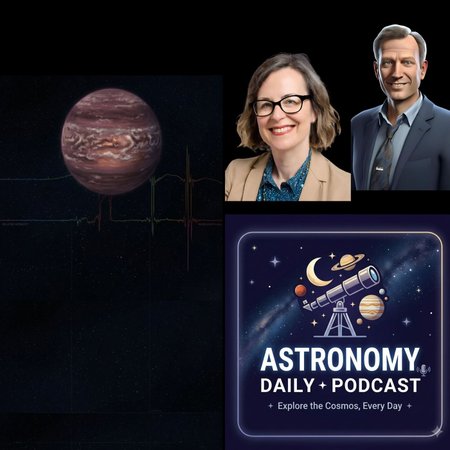
The coldest brown dwarf we know has weather. JWST watched water clouds thicken and thin on WISE 0855, a sunless world seven and a half light-years away — plus a star slowly eating a brown dwarf, ten minutes of X-rays after a half-second burst, a Soviet satellite breaking up over Western Australia, NASA's lunar cave hunt, and Mercury's best evening show of the year for the south. Stories Weather on a World Without a Sun Miles et al. used JWST NIRSpec to take a spectrum of WISE 0855 every 15 minutes for 11 hours. Carbon monoxide and phosphine rise and fall together as convection dredges deep gas upward, while patchy water clouds thicken and thin higher up — the first variable water clouds seen outside the Solar System. Source: University of Arizona release, 9 Oct 2026; arXiv:2609.20664 The Star That Eats Slowly ZTF J0440+2325: a red dwarf drawing gas from a 25-Jupiter-mass brown dwarf on an 87-minute orbit — the first confirmed stable mass transfer from a substellar object onto a star. Householder, Burdge et al., Nature Astronomy, 5 Oct 2026. Source: Nature Astronomy (2026); arXiv:2603.17039 Ten Minutes After Half a Second Einstein Probe caught ~560 s of soft X-rays after the 0.37 s GRB 250704B, at redshift 0.661 with no supernova — pointing to a compact-object merger and possibly a newborn magnetar. Science Bulletin, 2026. Source: DOI 10.1016/j.scib.2026.08.021; arXiv:2601.14137 A Dead Satellite Comes Apart Soviet weather satellite Meteor 2-7 (launched 1981) fragmented on 5 Oct at ~850 km, detected by LeoLabs' Western Australian radar. Cause unknown. Source: EarthSky, 9 Oct 2026; Space.com Quick hit: NASA Goes Caving on the Moon NASA's PRISM picks for the Moon Base program include GIMLI, which will probe the Marius Hills Pit for a lava tube, plus LEMS-SP and DISCO. Source: NASA RELEASE26-080, 30 Sept 2026 Skywatch Mercury at greatest eastern elongation — 24° up at sunset from Sydney vs 10° LA, 7.5° NY, 3° London. Crescent Moon near Venus and Mercury, Venus heading to inferior conjunction on the 24th, pre-dawn Mars and Jupiter for the north (Mars through the Beehive), Orionids 21–22 Oct. Source: Computed with PyEphem Sources · https://astrobiology.com/2026/10/09/first-detection-of-variable-water-clouds-outside-of-our-solar-system/ · https://arxiv.org/abs/2609.20664 · https://dspace.mit.edu/handle/1721.1/175765 · https://arxiv.org/abs/2603.17039 · https://www.arxiv.org/abs/2601.14137 · https://earthsky.org/?p=560313 · https://www.space.com/space-exploration/satellites/a-dead-soviet-satellite-just-broke-apart-in-orbit-again-experts-say-its-part-of-a-worrying-trend · https://nasa.gov/news-release/nasa-adds-new-science-investigations-for-moon-base
Become a supporter of this podcast: https://www.spreaker.com/podcast/astronomy-daily-latest-space-news--5648921/support.
Sponsor Details:
Ensure your online privacy by using NordVPN. To get our special listener deal and save a lot of money, visit www.astronomydaily.io/nordvpn. You'll be glad you did!
Get the best secure and private email on the planet. Stop your Government, google and who knows who else spying on every email you write. Do what we did and use ProtonMail. They beleive in privacy and there are no ads in their business model...yet they still provide a free forever service. Check them out and get out special deal at www.astronomydaily.io/protonmail
Become a supporter of Astronomy Daily by joining our Supporters Club. Commercial free episodes daily are only a click way... Click Here
This episode includes AI-generated content.
Other episodes of this podcast
Astronomy Daily: Latest Space News
Starship’s Double Catch Attempt, Euclid Opens Its Sky Survey, a Robot Builds in Orbit...
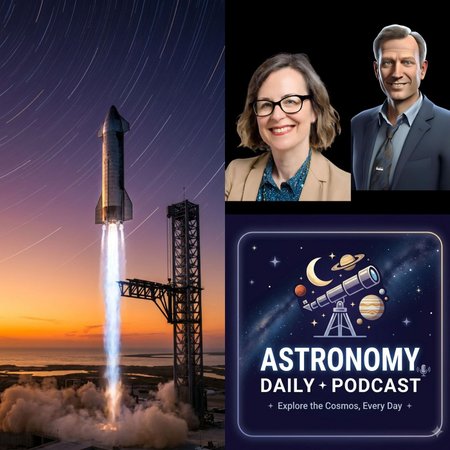
SpaceX is targeting today for Starship Flight 15, and for the first time it will try to catch both the Super Heavy booster and the Starship upper stage back at the launch tower, the ship after more than 22 hours and about 14 orbits. We walk through the plan, the timings for both hemispheres, and the three caveats that matter. Also: ESA's Euclid telescope opens about 1,900 square degrees of sky to the world in its first major data release; Caltech's ASTRA robot assembles the first piece of structure ever built autonomously in orbit; Voyager 1 closes in on one light-day from Earth; and Mars and Jupiter draw to 1.2 degrees apart in the pre-dawn sky. In this episode · Starship Flight 15: targeted for Fri 13 Nov, 4:45 pm CT (22:45 UTC; 9:45 am AEDT Sat). First attempt to catch both booster and ship. · Euclid DR1-Foundation: about 1,900 square degrees and 1.8 petabytes, public from 12 November. Cosmology products follow in mid-2027. · ASTRA: a Caltech/DARPA robot assembles a truss bay in low Earth orbit, a first. · Quick hits: Voyager 1 one light-day on 18 Nov; BepiColombo at Mercury 21 Nov; Hera's Dimorphos close-ups 25 Nov. · Skywatch: Mars and Jupiter 1.2° apart on 16 Nov; Venus and Spica; Leonids 17–18 Nov; Saturn in the evening. Sources · Starship Flight 15 awaits FAA green light — NASASpaceflight — https://www.nasaspaceflight.com/2026/11/starship-flight-15-awaits-faa/ · Starship Flight 15 will try to catch both stages — KeepTrack — https://keeptrack.space/x-report/spacex-brief-2026-11-09 · Euclid DR1 MER Catalog — Caltech/IPAC IRSA — https://www.ipac.caltech.edu/doi/10.26131/IRSA673 · Euclid timeline — ESA — https://www.cosmos.esa.int/web/euclid/timeline · ESA Datalabs Euclid Hackathon 2026 — https://www.cosmos.esa.int/web/esa-datalabs-euclid-hackathon-2026 · NOM4D program demonstrates automated in-space assembly — DARPA — https://www.darpa.mil/news/2026/nom4d-program-demonstrates-automated-in-space-assembly · Caltech robotic space demo successfully builds in space — Caltech — https://www.caltech.edu/about/news/caltech-robotic-space-demo-successfully-builds-in-space · Voyager 1 to reach 1 light-day — EarthSky — https://earthsky.org/space/voyager-1-1-light-day-from-earth-november-17-18-2026/ · What's Up: November 2026 — NASA — https://science.nasa.gov/solar-system/skywatching/whats-up-november-2026-skywatching-tips-from-nasa/ Become a supporter of this podcast: https://www.spreaker.com/podcast/astronomy-daily-latest-space-news--5648921/support . Sponsor Details: Ensure your online privacy by using NordVPN . To get our special listener deal and save a lot of money, visit www.astronomydaily.io/nordvpn . You'll be glad you did! Get the best secure and private email on the planet. Stop your Government, google and who knows who else spying on every email you write. Do what we did and use ProtonMail. They beleive in privacy and there are no ads in their business model...yet they still provide a free forever service. Check them out and get out special deal at www.astronomydaily.io/protonmail Become a supporter of Astronomy Daily by joining our Supporters Club. Commercial free episodes daily are only a click way... Click Here This episode includes AI-generated content.
Astronomy Daily: Latest Space News
A Planet Vanishes from View: Uranus’ Shifting Fields, Meerkat’s Hydrogen Map...
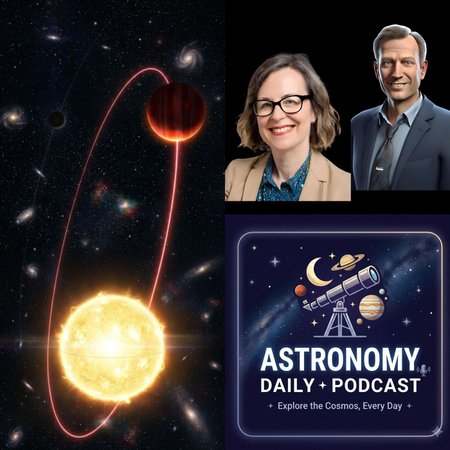
Show notes A hot Jupiter called TOI-2535 b has become the first planet around a single star seen to stop transiting, tipped out of line by an unseen neighbour. Plus: why Uranus and Neptune have scrambled magnetic fields, MeerKAT measuring how cosmic hydrogen clusters, Euclid's first big data release, ESCAPADE heading for Mars, Starship Flight 15's double-catch attempt, the 2026 ozone hole, and a both-hemispheres sky with Mars and Jupiter 1.2 degrees apart. The planet that stopped transiting. TOI-2535 b, an 8.24-day hot Jupiter ~1,000 light-years away, ran up to ~6 hours early or late and its transits shortened and faded over seven years of TESS data until they vanished in 2026. A hidden companion of at least Saturn mass, likely in resonance on a tilted orbit, is making both orbits precess. Transits should return in 30–50 years. Yee, Petigura et al., The Astrophysical Journal Letters, 9 Nov 2026. Ice giants' scrambled magnetic fields. Dynamo models with electrical conductivity rising with depth reproduce Uranus- and Neptune-like fields, and suggest their tilt could shift by tens of degrees within decades. Aurora observations could test for change since Voyager 2. Yan et al., Communications Physics. MeerKLASS hears the cosmic web. Running MeerKAT's 64 dishes as independent telescopes, the MeerKLASS collaboration detected the 21-cm hydrogen power spectrum on cosmological scales at z = 0.42 over ~236 square degrees, signal-to-noise 6.2. MNRAS. Euclid DR1-Foundation. ~1,900 square degrees (about 1,400 in the southern sky), ~1.8 PB of images, catalogues and spectra. Weak-lensing and clustering products follow in mid-2027. Quick hits. ESCAPADE Blue and Gold complete powered Earth flybys, Mars arrival Sept 2027; Starship Flight 15 targeted NET 13 Nov 22:45 UTC; 2026 Antarctic ozone hole seventh largest in 48 years, recovery on track. Skywatch. Mars–Jupiter 1.19° on 16 Nov (pre-dawn, north-favoured); Venus 1.2° from Spica, a 10%-lit crescent; Saturn high in southern evenings; Leonids peak 17–18 Nov; first quarter 17 Nov, full Moon 24 Nov. Sources · UCLA Newsroom — First known 'disappearing planet' — https://newsroom.ucla.edu/releases/first-known-disappearing-planet-neighbor-wobble-like-top · Yee et al., ApJL 1011 L60 — https://iopscience.iop.org/article/10.3847/2041-8213/aeb4a4 · arXiv 2611.13343 — https://arxiv.org/abs/2611.13343 · Yan et al., Communications Physics — https://www.nature.com/articles/s42005-026-02841-y · UT Austin Jackson School release — https://www.jsg.utexas.edu/news/2026/11/wacky-magnetic-fields-of-ice-giants-explained/ · University of Portsmouth — MeerKLASS — https://www.port.ac.uk/news-events-and-blogs/news/breakthrough-cosmic-hydrogen-measurement-could-transform-our-view-of-the-universe · MNRAS stag1911 (DOI) — https://doi.org/10.1093/mnras/stag1911 · Caltech/IPAC — Euclid DR1 — https://euclid.caltech.edu/page/euclid-dr1 · ESA — DR1 timeline — https://www.cosmos.esa.int/web/euclid/dr1-timeline · Berkeley News — ESCAPADE — http://news.berkeley.edu/2026/11/09/berkeleys-escapade-spacecraft-say-goodbye-to-earth-next-stop-mars/ · NextSpaceflight — Starship Flight 15 — https://nextspaceflight.com/launches/details/8403/ Become a supporter of this podcast: https://www.spreaker.com/podcast/astronomy-daily-latest-space-news--5648921/support . Sponsor Details: Ensure your online privacy by using NordVPN . To get our special listener deal and save a lot of money, visit www.astronomydaily.io/nordvpn . You'll be glad you did! Get the best secure and private email on the planet. Stop your Government, google and who knows who else spying on every email you write. Do what we did and use ProtonMail. They beleive in privacy and there are no ads in their business model...yet they still provide a free forever service. Check them out and get out special deal at www.astronomydaily.io/protonmail Become a supporter of Astronomy Daily by joining our Supporters Club. Commercial free episodes daily are only a click way... Click Here This episode includes AI-generated content.
Astronomy Daily: Latest Space News
Curiosity’s Spare Rover Heads to the Moon: Gravity Reconnection, Record-Cold Atoms...
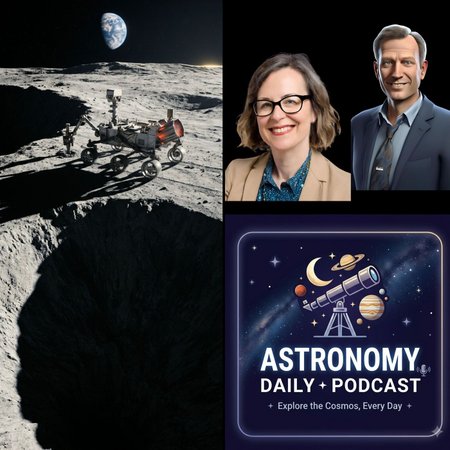
Show notes NASA turns Curiosity's spare test-bed rover into PROMISE, a nuclear-powered rover bound for the Moon's south pole, as part of a sweep of Moon Base awards. Plus: a theory of 'gravitational reconnection' hidden in Einstein's equations, a record 9.7-picokelvin quantum gas aboard China's Tiangong space station, ESCAPADE's twin burns over southern Australia, and a both-hemispheres skywatch. NASA's PROMISE rover and the Moon Base awards NASA Release 26-095 (7 Nov 2026) and PROMISE mission page. JPL is converting the duplicate Curiosity test-bed rover, powered by a flight-spare MMRTG, for a late-2028 launch and an 18-month mission at the lunar south pole. Blue Origin: $94M base + $140M option to deliver it on Mark 1. Also: eight CLPS 2 companies ($10B maximum, 10 years), CLPS 1 raised to $4.2B, six VADR task orders (~$1.3B), a 2028 Starship cislunar communications demo. https://www.nasa.gov/news-release/nasa-awards-moon-base-transportation-technology-science-projects/ https://www.nasa.gov/mission/promise/ Gravitational reconnection Comisso (Columbia) & Asenjo (Universidad Adolfo Ibáñez), 'Reconnection of Gravitational Fields', Physical Review D 114, 084095, 28 Oct 2026, DOI 10.1103/lmqy-pf9k; preprint arXiv 2609.25241 (Sept 2026). Theoretical only. https://news.columbia.edu/news/can-gravitational-fields-break-and-reconnect-einsteins-equations-suggest-they-can https://arxiv.org/abs/2609.25241 Quantum gas below 10 picokelvin on Tiangong 'Quantum gases below 10 picokelvin in space', Science (First Release, 5 Nov 2026), DOI 10.1126/science.aea5324. ~20,000 Rb-87 atoms, 9.7 pK equivalent temperature, 7 s observation (CAS). Peking University, SIOM and CSU-CAS. https://www.science.org/doi/10.1126/science.aea5324 https://www.sciencenews.org/article/lowest-temperature-china-space-station ESCAPADE's powered Earth flybys NASA ESCAPADE blog (2 Nov 2026). Blue's burn 8:51 p.m. AEDT 7 Nov; Gold's 9:51 p.m. AEDT 9 Nov, both over southern Australia; Mars arrival 7 and 9 Sept 2027. https://science.nasa.gov/blogs/escapade/2026/11/02/nasas-twin-escapade-spacecraft-to-slingshot-past-earth-on-way-to-mars/ Quick hits Starship Flight 15 targeted Fri 13 Nov, 22:45 UTC, pending regulatory approval; Voyager 1 one light-day ~18 Nov; Euclid DR1-Foundation due in November. https://www.valleycentral.com/news/local-news/spacex-plans-to-launch-starship-15-flight-on-nov-13/ https://www.cosmos.esa.int/web/euclid/dr1-timeline Skywatch New Moon 9 Nov. Venus about 1° from Spica before dawn 9–10 Nov (higher from the north). Mars and Jupiter close to ~1.2° on 16 Nov (our calculation). Crescent Moon ~2° from Antares on the evening of 11 Nov (southern-favoured). Saturn high in southern evenings. Northern Taurids 11–12 Nov; Leonids 17 Nov. Four-galaxy challenge for southern observers. Solar viewing only with ISO 12312-2 certified filters. Become a supporter of this podcast: https://www.spreaker.com/podcast/astronomy-daily-latest-space-news--5648921/support . Sponsor Details: Ensure your online privacy by using NordVPN . To get our special listener deal and save a lot of money, visit www.astronomydaily.io/nordvpn . You'll be glad you did! Get the best secure and private email on the planet. Stop your Government, google and who knows who else spying on every email you write. Do what we did and use ProtonMail. They beleive in privacy and there are no ads in their business model...yet they still provide a free forever service. Check them out and get out special deal at www.astronomydaily.io/protonmail Become a supporter of Astronomy Daily by joining our Supporters Club. Commercial free episodes daily are only a click way... Click Here This episode includes AI-generated content.
audio playback progress

0:00:00-:--:--