Astronomy Daily: Latest Space News
Eclipse Eve: Totality Returns to Europe
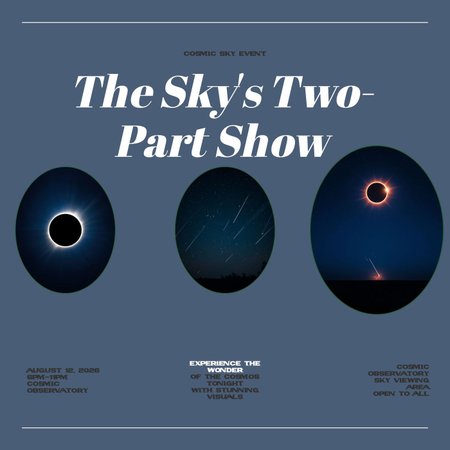
Astronomy Daily · S05E164 “Eclipse Eve” · Tuesday 11 August 2026. Sources are primary/agency where possible; aggregator dates were checked against originals. In this episode • LEAD — The 12 August total solar eclipse: the only total eclipse of 2026 and the first over mainland Europe since 1999. Totality arcs from Siberia over the North Pole to eastern Greenland, western Iceland, northern Spain and a sliver of Portugal; maximum totality ~2 min 18 s. Partial for much of North America near sunset; not visible from Australia. ESA livestreams from the Javalambre Observatory, Spain. • MIDDLE 1 — A state CASC Long March 7A exploded ~85 seconds after lifting off from Wenchang on 10 August, a total loss (payload reported as the Zhongxing-4B communications satellite). Separately, Landspace’s private Zhuque-3 was on the same-night manifest from Jiuquan for its second propulsive landing-legs recovery attempt — outcome unconfirmed at recording. China’s first orbital-booster landing (net-capture, Long March 10B) already succeeded on 10 July. • MIDDLE 2 — The Perseids peak overnight 12–13 August under a New Moon — the darkest conditions in roughly two decades. Parent comet 109P/Swift-Tuttle. Realistic ~30–50 meteors/hr from dark sites (nominal ~100), with a slim chance of a dust-trail boost; the next confidently forecast outburst is 2028. • MIDDLE 3 — Japan’s H3 launched Michibiki No. 7 (QZS-7) from Tanegashima, bringing the Quasi-Zenith Satellite System up to the strength Japan needs to run it as a standalone service — a regional navigation layer that keeps a satellite near the zenith over Japan/Asia-Pacific, reinforcing GPS and building navigation resilience. The satellite also hosts a US Space Force space-surveillance sensor (SACHI). • CLOSER — Both-hemispheres skywatch: eclipse viewing times (totality window ~16:58–18:34 UT, greatest ~17:46 UT) and the ISO 12312-2 eye-safety rule; Perseid how-to for the North (best 2 a.m.–dawn); and Southern-Hemisphere content — pre-dawn planets, evening Venus, Comet 10P/Tempel 2. Eye safety • A partial eclipse is never safe to view with the naked eye. Use ISO 12312-2 certified eclipse glasses/viewers, or indirect projection (pinhole). Direct viewing is only safe during true totality, and only inside the path (Greenland, Iceland, Spain). Links • astronomydaily.io — full back-catalogue, daily news feed, listener reviews, newsletter sign-up, contact form • @AstroDailyPod on your platform of choice
Become a supporter of this podcast: https://www.spreaker.com/podcast/astronomy-daily-latest-space-news--5648921/support.
Sponsor Details:
Ensure your online privacy by using NordVPN. To get our special listener deal and save a lot of money, visit www.astronomydaily.io/nordvpn. You'll be glad you did!
Get the best secure and private email on the planet. Stop your Government, google and who knows who else spying on every email you write. Do what we did and use ProtonMail. They beleive in privacy and there are no ads in their business model...yet they still provide a free forever service. Check them out and get out special deal at www.astronomydaily.io/protonmail
Become a supporter of Astronomy Daily by joining our Supporters Club. Commercial free episodes daily are only a click way... Click Here
This episode includes AI-generated content.
Other episodes of this podcast
Astronomy Daily: Latest Space News
Starship’s Double Catch Attempt, Euclid Opens Its Sky Survey, a Robot Builds in Orbit...
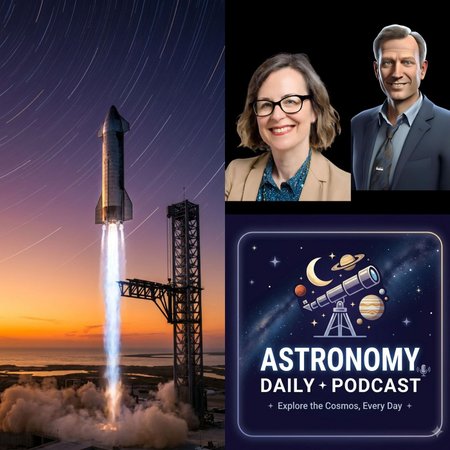
SpaceX is targeting today for Starship Flight 15, and for the first time it will try to catch both the Super Heavy booster and the Starship upper stage back at the launch tower, the ship after more than 22 hours and about 14 orbits. We walk through the plan, the timings for both hemispheres, and the three caveats that matter. Also: ESA's Euclid telescope opens about 1,900 square degrees of sky to the world in its first major data release; Caltech's ASTRA robot assembles the first piece of structure ever built autonomously in orbit; Voyager 1 closes in on one light-day from Earth; and Mars and Jupiter draw to 1.2 degrees apart in the pre-dawn sky. In this episode · Starship Flight 15: targeted for Fri 13 Nov, 4:45 pm CT (22:45 UTC; 9:45 am AEDT Sat). First attempt to catch both booster and ship. · Euclid DR1-Foundation: about 1,900 square degrees and 1.8 petabytes, public from 12 November. Cosmology products follow in mid-2027. · ASTRA: a Caltech/DARPA robot assembles a truss bay in low Earth orbit, a first. · Quick hits: Voyager 1 one light-day on 18 Nov; BepiColombo at Mercury 21 Nov; Hera's Dimorphos close-ups 25 Nov. · Skywatch: Mars and Jupiter 1.2° apart on 16 Nov; Venus and Spica; Leonids 17–18 Nov; Saturn in the evening. Sources · Starship Flight 15 awaits FAA green light — NASASpaceflight — https://www.nasaspaceflight.com/2026/11/starship-flight-15-awaits-faa/ · Starship Flight 15 will try to catch both stages — KeepTrack — https://keeptrack.space/x-report/spacex-brief-2026-11-09 · Euclid DR1 MER Catalog — Caltech/IPAC IRSA — https://www.ipac.caltech.edu/doi/10.26131/IRSA673 · Euclid timeline — ESA — https://www.cosmos.esa.int/web/euclid/timeline · ESA Datalabs Euclid Hackathon 2026 — https://www.cosmos.esa.int/web/esa-datalabs-euclid-hackathon-2026 · NOM4D program demonstrates automated in-space assembly — DARPA — https://www.darpa.mil/news/2026/nom4d-program-demonstrates-automated-in-space-assembly · Caltech robotic space demo successfully builds in space — Caltech — https://www.caltech.edu/about/news/caltech-robotic-space-demo-successfully-builds-in-space · Voyager 1 to reach 1 light-day — EarthSky — https://earthsky.org/space/voyager-1-1-light-day-from-earth-november-17-18-2026/ · What's Up: November 2026 — NASA — https://science.nasa.gov/solar-system/skywatching/whats-up-november-2026-skywatching-tips-from-nasa/ Become a supporter of this podcast: https://www.spreaker.com/podcast/astronomy-daily-latest-space-news--5648921/support . Sponsor Details: Ensure your online privacy by using NordVPN . To get our special listener deal and save a lot of money, visit www.astronomydaily.io/nordvpn . You'll be glad you did! Get the best secure and private email on the planet. Stop your Government, google and who knows who else spying on every email you write. Do what we did and use ProtonMail. They beleive in privacy and there are no ads in their business model...yet they still provide a free forever service. Check them out and get out special deal at www.astronomydaily.io/protonmail Become a supporter of Astronomy Daily by joining our Supporters Club. Commercial free episodes daily are only a click way... Click Here This episode includes AI-generated content.
Astronomy Daily: Latest Space News
A Planet Vanishes from View: Uranus’ Shifting Fields, Meerkat’s Hydrogen Map...
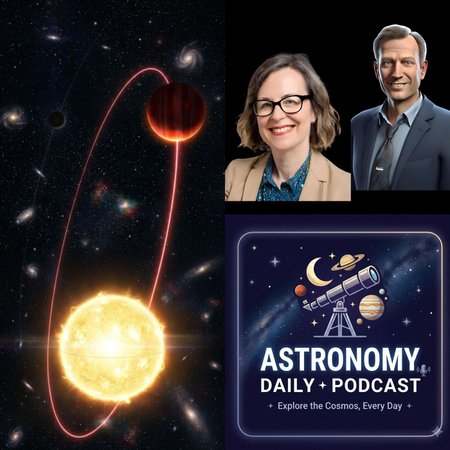
Show notes A hot Jupiter called TOI-2535 b has become the first planet around a single star seen to stop transiting, tipped out of line by an unseen neighbour. Plus: why Uranus and Neptune have scrambled magnetic fields, MeerKAT measuring how cosmic hydrogen clusters, Euclid's first big data release, ESCAPADE heading for Mars, Starship Flight 15's double-catch attempt, the 2026 ozone hole, and a both-hemispheres sky with Mars and Jupiter 1.2 degrees apart. The planet that stopped transiting. TOI-2535 b, an 8.24-day hot Jupiter ~1,000 light-years away, ran up to ~6 hours early or late and its transits shortened and faded over seven years of TESS data until they vanished in 2026. A hidden companion of at least Saturn mass, likely in resonance on a tilted orbit, is making both orbits precess. Transits should return in 30–50 years. Yee, Petigura et al., The Astrophysical Journal Letters, 9 Nov 2026. Ice giants' scrambled magnetic fields. Dynamo models with electrical conductivity rising with depth reproduce Uranus- and Neptune-like fields, and suggest their tilt could shift by tens of degrees within decades. Aurora observations could test for change since Voyager 2. Yan et al., Communications Physics. MeerKLASS hears the cosmic web. Running MeerKAT's 64 dishes as independent telescopes, the MeerKLASS collaboration detected the 21-cm hydrogen power spectrum on cosmological scales at z = 0.42 over ~236 square degrees, signal-to-noise 6.2. MNRAS. Euclid DR1-Foundation. ~1,900 square degrees (about 1,400 in the southern sky), ~1.8 PB of images, catalogues and spectra. Weak-lensing and clustering products follow in mid-2027. Quick hits. ESCAPADE Blue and Gold complete powered Earth flybys, Mars arrival Sept 2027; Starship Flight 15 targeted NET 13 Nov 22:45 UTC; 2026 Antarctic ozone hole seventh largest in 48 years, recovery on track. Skywatch. Mars–Jupiter 1.19° on 16 Nov (pre-dawn, north-favoured); Venus 1.2° from Spica, a 10%-lit crescent; Saturn high in southern evenings; Leonids peak 17–18 Nov; first quarter 17 Nov, full Moon 24 Nov. Sources · UCLA Newsroom — First known 'disappearing planet' — https://newsroom.ucla.edu/releases/first-known-disappearing-planet-neighbor-wobble-like-top · Yee et al., ApJL 1011 L60 — https://iopscience.iop.org/article/10.3847/2041-8213/aeb4a4 · arXiv 2611.13343 — https://arxiv.org/abs/2611.13343 · Yan et al., Communications Physics — https://www.nature.com/articles/s42005-026-02841-y · UT Austin Jackson School release — https://www.jsg.utexas.edu/news/2026/11/wacky-magnetic-fields-of-ice-giants-explained/ · University of Portsmouth — MeerKLASS — https://www.port.ac.uk/news-events-and-blogs/news/breakthrough-cosmic-hydrogen-measurement-could-transform-our-view-of-the-universe · MNRAS stag1911 (DOI) — https://doi.org/10.1093/mnras/stag1911 · Caltech/IPAC — Euclid DR1 — https://euclid.caltech.edu/page/euclid-dr1 · ESA — DR1 timeline — https://www.cosmos.esa.int/web/euclid/dr1-timeline · Berkeley News — ESCAPADE — http://news.berkeley.edu/2026/11/09/berkeleys-escapade-spacecraft-say-goodbye-to-earth-next-stop-mars/ · NextSpaceflight — Starship Flight 15 — https://nextspaceflight.com/launches/details/8403/ Become a supporter of this podcast: https://www.spreaker.com/podcast/astronomy-daily-latest-space-news--5648921/support . Sponsor Details: Ensure your online privacy by using NordVPN . To get our special listener deal and save a lot of money, visit www.astronomydaily.io/nordvpn . You'll be glad you did! Get the best secure and private email on the planet. Stop your Government, google and who knows who else spying on every email you write. Do what we did and use ProtonMail. They beleive in privacy and there are no ads in their business model...yet they still provide a free forever service. Check them out and get out special deal at www.astronomydaily.io/protonmail Become a supporter of Astronomy Daily by joining our Supporters Club. Commercial free episodes daily are only a click way... Click Here This episode includes AI-generated content.
Astronomy Daily: Latest Space News
Curiosity’s Spare Rover Heads to the Moon: Gravity Reconnection, Record-Cold Atoms...
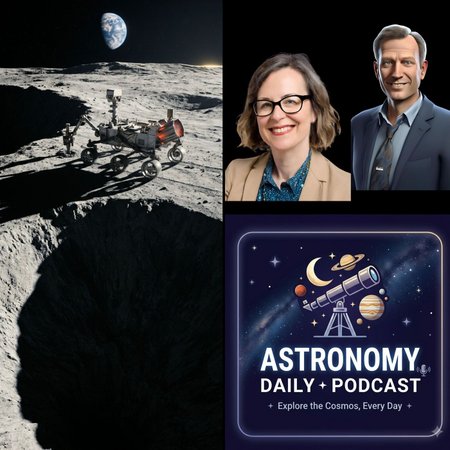
Show notes NASA turns Curiosity's spare test-bed rover into PROMISE, a nuclear-powered rover bound for the Moon's south pole, as part of a sweep of Moon Base awards. Plus: a theory of 'gravitational reconnection' hidden in Einstein's equations, a record 9.7-picokelvin quantum gas aboard China's Tiangong space station, ESCAPADE's twin burns over southern Australia, and a both-hemispheres skywatch. NASA's PROMISE rover and the Moon Base awards NASA Release 26-095 (7 Nov 2026) and PROMISE mission page. JPL is converting the duplicate Curiosity test-bed rover, powered by a flight-spare MMRTG, for a late-2028 launch and an 18-month mission at the lunar south pole. Blue Origin: $94M base + $140M option to deliver it on Mark 1. Also: eight CLPS 2 companies ($10B maximum, 10 years), CLPS 1 raised to $4.2B, six VADR task orders (~$1.3B), a 2028 Starship cislunar communications demo. https://www.nasa.gov/news-release/nasa-awards-moon-base-transportation-technology-science-projects/ https://www.nasa.gov/mission/promise/ Gravitational reconnection Comisso (Columbia) & Asenjo (Universidad Adolfo Ibáñez), 'Reconnection of Gravitational Fields', Physical Review D 114, 084095, 28 Oct 2026, DOI 10.1103/lmqy-pf9k; preprint arXiv 2609.25241 (Sept 2026). Theoretical only. https://news.columbia.edu/news/can-gravitational-fields-break-and-reconnect-einsteins-equations-suggest-they-can https://arxiv.org/abs/2609.25241 Quantum gas below 10 picokelvin on Tiangong 'Quantum gases below 10 picokelvin in space', Science (First Release, 5 Nov 2026), DOI 10.1126/science.aea5324. ~20,000 Rb-87 atoms, 9.7 pK equivalent temperature, 7 s observation (CAS). Peking University, SIOM and CSU-CAS. https://www.science.org/doi/10.1126/science.aea5324 https://www.sciencenews.org/article/lowest-temperature-china-space-station ESCAPADE's powered Earth flybys NASA ESCAPADE blog (2 Nov 2026). Blue's burn 8:51 p.m. AEDT 7 Nov; Gold's 9:51 p.m. AEDT 9 Nov, both over southern Australia; Mars arrival 7 and 9 Sept 2027. https://science.nasa.gov/blogs/escapade/2026/11/02/nasas-twin-escapade-spacecraft-to-slingshot-past-earth-on-way-to-mars/ Quick hits Starship Flight 15 targeted Fri 13 Nov, 22:45 UTC, pending regulatory approval; Voyager 1 one light-day ~18 Nov; Euclid DR1-Foundation due in November. https://www.valleycentral.com/news/local-news/spacex-plans-to-launch-starship-15-flight-on-nov-13/ https://www.cosmos.esa.int/web/euclid/dr1-timeline Skywatch New Moon 9 Nov. Venus about 1° from Spica before dawn 9–10 Nov (higher from the north). Mars and Jupiter close to ~1.2° on 16 Nov (our calculation). Crescent Moon ~2° from Antares on the evening of 11 Nov (southern-favoured). Saturn high in southern evenings. Northern Taurids 11–12 Nov; Leonids 17 Nov. Four-galaxy challenge for southern observers. Solar viewing only with ISO 12312-2 certified filters. Become a supporter of this podcast: https://www.spreaker.com/podcast/astronomy-daily-latest-space-news--5648921/support . Sponsor Details: Ensure your online privacy by using NordVPN . To get our special listener deal and save a lot of money, visit www.astronomydaily.io/nordvpn . You'll be glad you did! Get the best secure and private email on the planet. Stop your Government, google and who knows who else spying on every email you write. Do what we did and use ProtonMail. They beleive in privacy and there are no ads in their business model...yet they still provide a free forever service. Check them out and get out special deal at www.astronomydaily.io/protonmail Become a supporter of Astronomy Daily by joining our Supporters Club. Commercial free episodes daily are only a click way... Click Here This episode includes AI-generated content.
audio playback progress

0:00:00-:--:--