
Astronomy Daily: Latest Space News
Spacecraft Drama, Galactic Neighborhoods, and the Push for a Circular Space Economy
- Emergency Return of Shenzhou 20: China's Shenzhou 20 spacecraft is making an uncrewed emergency return to Earth after sustaining damage from a micrometeoroid, which caused a crack in its window. The crew safely returned on a different vessel, marking a significant first for China's space program.
- Galactic Neighborhoods Matter: The Deep Extragalactic Visible Legacy Survey (DEVELS) reveals that a galaxy's local environment significantly influences its evolution. Galaxies in crowded clusters exhibit slower star formation rates compared to isolated ones, providing crucial insights into cosmic evolution.
- Launch Week Extravaganza: This week sees 10 scheduled orbital launches, including five Starlink missions by SpaceX, South Korea's COMSAT 7 satellite launch by Arianespace, and Japan's H3 rocket carrying a critical GPS satellite, highlighting the rapid advancements in the global space industry.
- Ancient Mars Rivers: A new study identifies 16 massive ancient river drainage systems on Mars, suggesting a much wetter past. These findings offer promising locations for searching for signs of past Martian life, utilizing high-resolution data from Mars orbiters.
- Solar Activity Alert: The sun has unleashed a powerful X 1.9 class solar flare, causing radio blackouts and raising concerns about future solar activity. Forecasters are closely monitoring a larger sunspot region that could impact Earth with potential geomagnetic disturbances.
- Sustainable Space Practices: Experts advocate for a circular space economy to combat space debris, emphasizing the importance of designing durable, repairable satellites and creating multi-purpose space stations to ensure sustainable operations in orbit for future generations.
- For more cosmic updates, visit our website at astronomydaily.io. Join our community on social media by searching for #AstroDailyPod on Facebook, X, YouTubeMusic, TikTok, and our new Instagram account! Don’t forget to subscribe to the podcast on Apple Podcasts, Spotify, iHeartRadio, or wherever you get your podcasts.
- Thank you for tuning in. This is Avery and Anna signing off. Until next time, keep looking up and exploring the wonders of our universe.
Shenzhou 20 Emergency Return
[China National Space Administration](http://www.cnsa.gov.cn/)
DEVELS Survey Findings
[Astronomy Journal](https://www.astronomy.com/)
Launch Week Highlights
[NASA Launch Schedule](https://www.nasa.gov/launchschedule)
Mars River Systems Study
[Mars Reconnaissance Orbiter](https://mars.nasa.gov/mro/)
Solar Activity Reports
[NOAA Space Weather Prediction Center](https://www.swpc.noaa.gov/)
Circular Space Economy Initiatives
[Astroscale](https://astroscale.com/)
Become a supporter of this podcast: https://www.spreaker.com/podcast/astronomy-daily-space-news-updates--5648921/support.
Sponsor Details:
Ensure your online privacy by using NordVPN. To get our special listener deal and save a lot of money, visit www.bitesz.com/nordvpn. You'll be glad you did!
Sponsor Details:
Ensure your online privacy by using NordVPN. To get our special listener deal and save a lot of money, visit www.bitesz.com/nordvpn. You'll be glad you did!
Become a supporter of Astronomy Daily by joining our Supporters Club. Commercial free episodes daily are only a click way... Click Here
This episode includes AI-generated content.
Other episodes of this podcast
Astronomy Daily: Latest Space News
Stellar Breakthroughs: The Discovery of Deuterated Methanol and the First Green Star
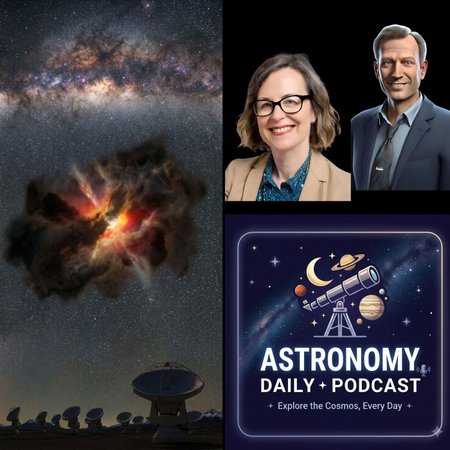
Show notes Episode 206 opens with the first results from ALMA's COMPASS survey: the first detection anywhere in interstellar space of fully deuterated methanol, and methanol masers turning up around more than half of a sample of young Sun-like stars. Then the first star that would look green, Magellanic Cloud pulsars recovered from decades-old Parkes data, a supernova caught days old when the universe was 1.2 billion years old, quick hits on Hera, CRS-35 and MMX, and a both-hemispheres skywatch built around the Orionids. Heavy methanol around a newborn star ALMA's COMPASS programme (11 protostars, 100+ hours, seven A&A papers) reports the first interstellar CD3OD around IRAS 4A2 in Perseus (Belloche, MPIfR) and methanol masers in more than half of its low-mass protostars (Jeong, SNU). Deuterium fraction as a formation clock; current models can't reproduce the pattern. The first green star Warwick's Hollands et al. (RASTI) compute white dwarf colours from spectra: WD J1330+6435 comes out chartreuse thanks to accreted sodium; WD J1011+2845 may be the reddest star known. Of 151 white dwarfs within 20 pc, about 1 in 30 is oddly coloured, and the median is white. Pulsars hiding in the Parkes archive Reprocessing Murriyang's Magellanic Cloud surveys finds six pulsars, five in the LMC including a 3.8 s spinner (Sengar et al., preprint); a separate search finds PSR J0103−72, the slowest radio pulsar in the SMC (Wang & Sengar, preprint). A supernova caught days old JWST's NEXUS survey caught AT 2026abck at z = 5.017 roughly 4–10 rest-frame days after explosion — the first robust z ≳ 5 transient in an unlensed field (preprint; no spectrum yet). Quick hits Hera's BRM-1 braking burn (result pending at recording), CRS-35 docks with the last iROSAs, and MMX launches Tuesday morning Japan time. Skywatch First quarter 18 Oct, Orionids peak 21–22 Oct with the Moon down before dawn everywhere, evening Mercury for the south, Venus heading into conjunction, Saturn after dark, Mars and Jupiter closing before dawn. Sources · ALMA — Cosmic Cocktail: ALMA Reveals Exotic Methanol Around Young Stars (7 Oct 2026) — https://www.almaobservatory.org/en/press-releases/cosmic-cocktail-alma-reveals-exotic-methanol-around-young-stars/ · Belloche et al., COMPASS VII, arXiv 2610.07279 — https://arxiv.org/abs/2610.07279 · University of Warwick — true colours of white dwarf stars — https://warwick.ac.uk/news/pressreleases/astronomers-reveal-true-colours-of-white-dwarf-stars/ · Hollands et al., RASTI DOI 10.1093/rasti/rzag069 — https://academic.oup.com/rasti/article/doi/10.1093/rasti/rzag069 · Sengar et al., arXiv 2610.12450 — https://arxiv.org/abs/2610.12450 · Wang & Sengar, arXiv 2610.12143 — https://arxiv.org/abs/2610.12143 · Zhuang, Shen et al., arXiv 2609.38373 — https://arxiv.org/abs/2609.38373 · ESA — Brake! Time for ESA's Hera asteroid mission to go slow — https://www.esa.int/Space_Safety/Hera/Brake!_Time_for_ESA_s_Hera_asteroid_mission_to_go_slow · NASA Space Station blog — CRS-35 docking — https://www.nasa.gov/blogs/spacestation/ · JAXA — MMX launch schedule — https://global.jaxa.jp/press/2026/08/20260820-1_e.html Become a supporter of this podcast: https://www.spreaker.com/podcast/astronomy-daily-latest-space-news--5648921/support . Sponsor Details: Ensure your online privacy by using NordVPN . To get our special listener deal and save a lot of money, visit www.astronomydaily.io/nordvpn . You'll be glad you did! Get the best secure and private email on the planet. Stop your Government, google and who knows who else spying on every email you write. Do what we did and use ProtonMail. They beleive in privacy and there are no ads in their business model...yet they still provide a free forever service. Check them out and get out special deal at www.astronomydaily.io/protonmail Become a supporter of Astronomy Daily by joining our Supporters Club. Commercial free episodes daily are only a click way... Click Here This episode includes AI-generated content.
Astronomy Daily: Latest Space News
Martian Mystery: Unveiling the Secrets of Arsia Mons' Elusive Clouds
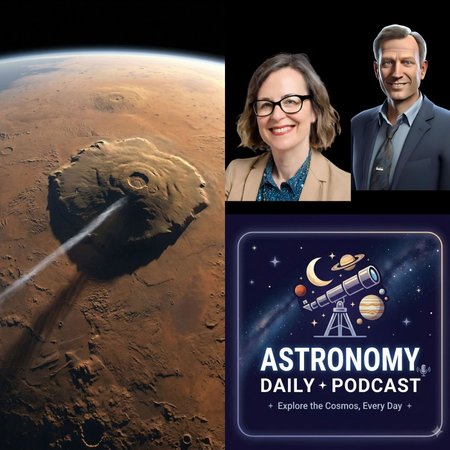
Show notes A cloud on Mars that forms only if textbook-theoretical physics really happens; Webb maps a hot Jupiter's edge angle by angle; multi-planet systems turn out to come in two families tied to their stars; and the Sagittarius dwarf galaxy's original disc is rebuilt from its own debris. Plus Hera's first braking burn, the station's final solar arrays, NASA ADS hands over to SciX, and a both-hemispheres skywatch. The Cloud That Shouldn't Exist Every morning in Mars's southern spring and summer, the Arsia Mons Elongated Cloud stretches up to 1,800 km from the 20 km volcano and vanishes within the day. A team led by Jorge Hernández-Bernal (LMD/CNRS/Sorbonne Université) could only reproduce it by adding homogeneous nucleation, in which vapour freezes with no dust seed, at supersaturation more than 100,000 times everyday Earth levels. A model result: sufficient, not yet observed directly. Nature Geoscience, 7 October 2026. A Map Around a Hot Jupiter's Edge Using JWST's NIRISS, NIRSpec and MIRI and the transmission strings method, Lili Alderson, Hannah Wakeford and colleagues mapped WASP-17 b's limb in 20° steps: ~860 K at the morning edge, ~1,520 K at the evening edge, the largest limb contrast yet. Data from March 2023. Nature Astronomy, 14 October 2026. Planetary Systems Come in Two Families Diego Turrini (INAF), Camilla Danielski and colleagues find 298 well-measured multi-planet systems split into a calm, compact low-mass family and a heavyweight family around metal-rich stars with about ten times more dynamical excitation. Nature Astronomy, 13 October 2026. Rewinding a Shredded Galaxy Zixi Guo, Xiang-Xiang Xue (NAOC) and colleagues reproduce a vertical metallicity gradient across the Sagittarius streams only if the dwarf began as a disc with an inverted-V metallicity profile, seen in 3 of 217 MaNGA dwarfs. Nature Astronomy, 13 October 2026. Quick hit Hera's 93-minute braking burn (BRM-1); CRS-35 and the ISS's final roll-out solar arrays; NASA ADS closes in November and becomes SciX. Skywatch Mercury and Venus in the southern evening sky; Venus inferior conjunction 24 Oct; crescent Moon in Ophiuchus; Sagittarius and WASP-17 high from Australia; Saturn all night; Mars and Jupiter closing pre-dawn toward 1.2° on 16 Nov; Orionids peak 21–22 Oct. Links · ESA: Mars's oddest cloud may be even odder than we thought (7 Oct 2026): https://www.esa.int/Science_Exploration/Space_Science/Mars_Express/Mars_s_oddest_cloud_may_be_even_odder_than_we_thought · Hernández-Bernal et al., Nature Geoscience (2026), DOI 10.1038/s41561-026-02089-9: https://doi.org/10.1038/s41561-026-02089-9 · Preprint: arXiv 2609.37259: https://arxiv.org/abs/2609.37259 · Alderson et al., A spatial map of the atmospheric limb of a hot Jupiter, Nature Astronomy (2026): https://www.nature.com/articles/s41550-026-02986-4 · Turrini, Danielski et al., Two families of multi-planet systems, Nature Astronomy (2026): https://www.nature.com/articles/s41550-026-02990-8 · INAF Media: Due famiglie di sistemi planetari (13 Oct 2026): https://www.media.inaf.it/2026/10/13/famiglie-esopianeti-stella-madre/ · Guo, Xue et al., A ∧-like metallicity profile in the disk of the Sagittarius dwarf galaxy, Nature Astronomy (2026): https://www.nature.com/articles/s41550-026-02996-2 · ESA: Brake! Time for ESA's Hera asteroid mission to go slow (7 Oct 2026): https://www.esa.int/Space_Safety/Hera/Brake!_Time_for_ESA_s_Hera_asteroid_mission_to_go_slow · Spaceflight Now: CRS-35 launch (13 Oct 2026): https://spaceflightnow.com/?p=74541 · Nature Astronomy editorial: Farewell NASA ADS (12 Oct 2026): https://www.nature.com/articles/s41550-026-03009-y astronomydaily.io · @AstroDailyPod · Bitesz.com Podcast Network Become a supporter of this podcast: https://www.spreaker.com/podcast/astronomy-daily-latest-space-news--5648921/support . Sponsor Details: Ensure your online privacy by using NordVPN . To get our special listener deal and save a lot of money, visit www.astronomydaily.io/nordvpn . You'll be glad you did! Get the best secure and private email on the planet. Stop your Government, google and who knows who else spying on every email you write. Do what we did and use ProtonMail. They beleive in privacy and there are no ads in their business model...yet they still provide a free forever service. Check them out and get out special deal at www.astronomydaily.io/protonmail Become a supporter of Astronomy Daily by joining our Supporters Club. Commercial free episodes daily are only a click way... Click Here This episode includes AI-generated content.
Astronomy Daily: Latest Space News
Cosmic Revelations: Artemis 2's Historic Observations and the Case of Hypernovae
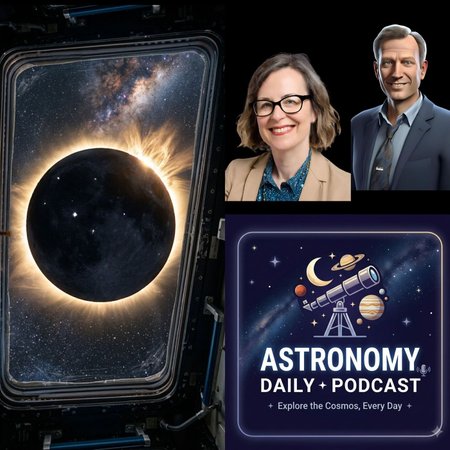
Show notes Six months after Artemis II swung around the far side of the Moon, NASA has published what the crew saw, said and sketched — including five faint impact flashes spotted during a 54-minute eclipse. Plus: two UCL papers that take apart the chemical evidence for hypernovae, Juno finds Jupiter's magnetodisk crumpled into ripples, and IISc simulations suggest magnetised white dwarfs could grow well past the Chandrasekhar limit. Skywatch: the crescent Moon meets Antares, Mercury and Venus favour the south, Mars leaves the Beehive, and Vesta at opposition. Artemis II Preliminary Lunar Science Report · Crew: Reid Wiseman, Victor Glover, Christina Koch (NASA) and Jeremy Hansen (CSA); lunar flyby 6 April 2026. · Five extremely faint impact flashes seen from ~74,000 km during a 54-minute eclipse behind the Moon; impactors estimated at no more than ~5 cm. · Crew-reported colours (blue = titanium-rich volcanic rock, brown = iron, green = glass); terminator observations as a proxy for south-pole lighting. · 'Hello, World' Earth image lit by moonlight; labelled southern Milky Way image (Crux, Carina, LMC). · Source: NASA Science, 'Artemis II: Sights & Sounds of Science', 7 Oct 2026 — science.nasa.gov/feature/artemis-ii-preliminary-lunar-science-report/ Hypernovae: the evidence that wasn't · Anmol Aggarwal & Ralph Schoenrich (Mullard Space Science Laboratory, UCL), two MNRAS papers; UCL release 5 Oct 2026. · Uneven ('stochastic') supernova enrichment explains three of four supposed hypernova-enriched stars; the fourth (silver- and uranium-rich halo giant) fits a neutron-star merger plus one ordinary supernova. · Source: ucl.ac.uk/news/2026/oct/ultra-powerful-star-explosions-might-not-have-occurred-after-all ; DOI 10.1093/mnras/stag610 Juno: Jupiter's rippling magnetodisk · Ruilong Guo (Shandong University) et al., Science China Earth Sciences 69(10), 2026; release 6 Oct 2026. · Repeated current-sheet crossings — four in ten minutes in one case — with reconnection signatures; a rotating, rippled sheet rather than a smooth flapping one. · Source: doi.org/10.1007/s11430-025-1870-9 White dwarfs beyond the Chandrasekhar limit · Zenia Zuraiq, Banibrata Mukhopadhyay (IISc) and collaborators incl. Christopher Tout, ApJL 2026; IISc release 9 Oct 2026. · Modified STARS code: a magnetised accreting white dwarf reaches ~2.4 solar masses vs ~1.4 without the field. · Source: iisc.ac.in/events/strong-magnetic-fields-could-allow-white-dwarfs-to-grow-beyond-the-chandrasekhar-limit/ Quick hit: Hera and MMX · ESA: Hera BRM-1, 93-minute braking burn early Thu 15 Oct; BRM-2 on 22 Oct. esa.int (Hera) · JAXA: MMX launch on H3 F10, 20 Oct 2026 04:41:03 JST from Tanegashima; samples to South Australia in 2031. Skywatch (computed for Sydney, LA, New York, London) · Tonight: crescent Moon near Antares — 1.3° from New York, 2.3° from LA and London (very low), 7° from Sydney. · Evening Mercury (24° up at sunset from Sydney) and Venus (heading to inferior conjunction ~24 Oct) favour the south. · Pre-dawn: Mars ~2° from the Beehive, Mars–Jupiter closing to ~1.2° on 16 Nov; Saturn in the evening; Southern Taurids; Vesta at opposition (mag 6.5, Cetus). · Solar safety: never view the Sun except through certified ISO 12312-2 filters. Become a supporter of this podcast: https://www.spreaker.com/podcast/astronomy-daily-latest-space-news--5648921/support . Sponsor Details: Ensure your online privacy by using NordVPN . To get our special listener deal and save a lot of money, visit www.astronomydaily.io/nordvpn . You'll be glad you did! Get the best secure and private email on the planet. Stop your Government, google and who knows who else spying on every email you write. Do what we did and use ProtonMail. They beleive in privacy and there are no ads in their business model...yet they still provide a free forever service. Check them out and get out special deal at www.astronomydaily.io/protonmail Become a supporter of Astronomy Daily by joining our Supporters Club. Commercial free episodes daily are only a click way... Click Here This episode includes AI-generated content.
audio playback progress

0:00:00-:--:--