
bitesz.com
Astronomy Daily: Latest Space News
Join hosts Anna & Avery for daily Space & Astronomy news, insights, and discoveries.Give us 10 minutes and we'll give
you the Universe!For more visit, our website and sign up for the free daily newsletter and check out our continually
updated newsfeed. www.astronomydaily.io.Follow us on X (formerly Twitter), Facebook, YouTube and TikTo... show more
you the Universe!For more visit, our website and sign up for the free daily newsletter and check out our continually
updated newsfeed. www.astronomydaily.io.Follow us on X (formerly Twitter), Facebook, YouTube and TikTo... show more
Astronomy Daily: Latest Space News
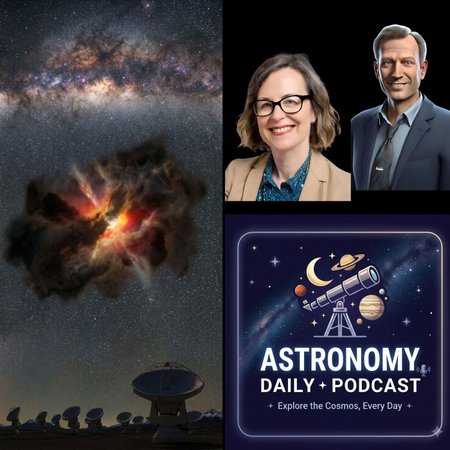
Stellar Breakthroughs: The Discovery of Deuterated Methanol and the First Green Star
Show notes Episode 206 opens with the first results from ALMA's COMPASS survey: the first detection anywhere in interstellar space of fully deuterated methanol, and methanol masers turning up around more than half of a sample of young Sun-like stars. Then the first star that would look green, Magellanic Cloud pulsars recovered from decades-old Parkes data, a supernova caught days old when the universe was 1.2 billion years old, quick hits on Hera, CRS-35 and MMX, and a both-hemispheres skywatch built around the Orionids. Heavy methanol around a newborn star ALMA's COMPASS programme (11 protostars, 100+ hours, seven A&A papers) reports the first interstellar CD3OD around IRAS 4A2 in Perseus (Belloche, MPIfR) and methanol masers in more than half of its low-mass protostars (Jeong, SNU). Deuterium fraction as a formation clock; current models can't reproduce the pattern. The first green star Warwick's Hollands et al. (RASTI) compute white dwarf colours from spectra: WD J1330+6435 comes out chartreuse thanks to accreted sodium; WD J1011+2845 may be the reddest star known. Of 151 white dwarfs within 20 pc, about 1 in 30 is oddly coloured, and the median is white. Pulsars hiding in the Parkes archive Reprocessing Murriyang's Magellanic Cloud surveys finds six pulsars, five in the LMC including a 3.8 s spinner (Sengar et al., preprint); a separate search finds PSR J0103−72, the slowest radio pulsar in the SMC (Wang & Sengar, preprint). A supernova caught days old JWST's NEXUS survey caught AT 2026abck at z = 5.017 roughly 4–10 rest-frame days after explosion — the first robust z ≳ 5 transient in an unlensed field (preprint; no spectrum yet). Quick hits Hera's BRM-1 braking burn (result pending at recording), CRS-35 docks with the last iROSAs, and MMX launches Tuesday morning Japan time. Skywatch First quarter 18 Oct, Orionids peak 21–22 Oct with the Moon down before dawn everywhere, evening Mercury for the south, Venus heading into conjunction, Saturn after dark, Mars and Jupiter closing before dawn. Sources · ALMA — Cosmic Cocktail: ALMA Reveals Exotic Methanol Around Young Stars (7 Oct 2026) — https://www.almaobservatory.org/en/press-releases/cosmic-cocktail-alma-reveals-exotic-methanol-around-young-stars/ · Belloche et al., COMPASS VII, arXiv 2610.07279 — https://arxiv.org/abs/2610.07279 · University of Warwick — true colours of white dwarf stars — https://warwick.ac.uk/news/pressreleases/astronomers-reveal-true-colours-of-white-dwarf-stars/ · Hollands et al., RASTI DOI 10.1093/rasti/rzag069 — https://academic.oup.com/rasti/article/doi/10.1093/rasti/rzag069 · Sengar et al., arXiv 2610.12450 — https://arxiv.org/abs/2610.12450 · Wang & Sengar, arXiv 2610.12143 — https://arxiv.org/abs/2610.12143 · Zhuang, Shen et al., arXiv 2609.38373 — https://arxiv.org/abs/2609.38373 · ESA — Brake! Time for ESA's Hera asteroid mission to go slow — https://www.esa.int/Space_Safety/Hera/Brake!_Time_for_ESA_s_Hera_asteroid_mission_to_go_slow · NASA Space Station blog — CRS-35 docking — https://www.nasa.gov/blogs/spacestation/ · JAXA — MMX launch schedule — https://global.jaxa.jp/press/2026/08/20260820-1_e.html Become a supporter of this podcast: https://www.spreaker.com/podcast/astronomy-daily-latest-space-news--5648921/support . Sponsor Details: Ensure your online privacy by using NordVPN . To get our special listener deal and save a lot of money, visit www.astronomydaily.io/nordvpn . You'll be glad you did! Get the best secure and private email on the planet. Stop your Government, google and who knows who else spying on every email you write. Do what we did and use ProtonMail. They beleive in privacy and there are no ads in their business model...yet they still provide a free forever service. Check them out and get out special deal at www.astronomydaily.io/protonmail Become a supporter of Astronomy Daily by joining our Supporters Club. Commercial free episodes daily are only a click way... Click Here This episode includes AI-generated content.
Astronomy Daily: Latest Space News
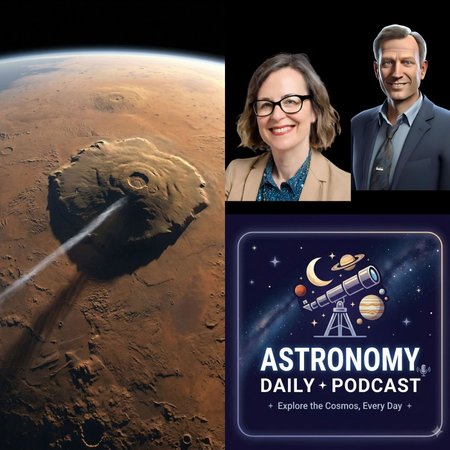
Martian Mystery: Unveiling the Secrets of Arsia Mons' Elusive Clouds
Show notes A cloud on Mars that forms only if textbook-theoretical physics really happens; Webb maps a hot Jupiter's edge angle by angle; multi-planet systems turn out to come in two families tied to their stars; and the Sagittarius dwarf galaxy's original disc is rebuilt from its own debris. Plus Hera's first braking burn, the station's final solar arrays, NASA ADS hands over to SciX, and a both-hemispheres skywatch. The Cloud That Shouldn't Exist Every morning in Mars's southern spring and summer, the Arsia Mons Elongated Cloud stretches up to 1,800 km from the 20 km volcano and vanishes within the day. A team led by Jorge Hernández-Bernal (LMD/CNRS/Sorbonne Université) could only reproduce it by adding homogeneous nucleation, in which vapour freezes with no dust seed, at supersaturation more than 100,000 times everyday Earth levels. A model result: sufficient, not yet observed directly. Nature Geoscience, 7 October 2026. A Map Around a Hot Jupiter's Edge Using JWST's NIRISS, NIRSpec and MIRI and the transmission strings method, Lili Alderson, Hannah Wakeford and colleagues mapped WASP-17 b's limb in 20° steps: ~860 K at the morning edge, ~1,520 K at the evening edge, the largest limb contrast yet. Data from March 2023. Nature Astronomy, 14 October 2026. Planetary Systems Come in Two Families Diego Turrini (INAF), Camilla Danielski and colleagues find 298 well-measured multi-planet systems split into a calm, compact low-mass family and a heavyweight family around metal-rich stars with about ten times more dynamical excitation. Nature Astronomy, 13 October 2026. Rewinding a Shredded Galaxy Zixi Guo, Xiang-Xiang Xue (NAOC) and colleagues reproduce a vertical metallicity gradient across the Sagittarius streams only if the dwarf began as a disc with an inverted-V metallicity profile, seen in 3 of 217 MaNGA dwarfs. Nature Astronomy, 13 October 2026. Quick hit Hera's 93-minute braking burn (BRM-1); CRS-35 and the ISS's final roll-out solar arrays; NASA ADS closes in November and becomes SciX. Skywatch Mercury and Venus in the southern evening sky; Venus inferior conjunction 24 Oct; crescent Moon in Ophiuchus; Sagittarius and WASP-17 high from Australia; Saturn all night; Mars and Jupiter closing pre-dawn toward 1.2° on 16 Nov; Orionids peak 21–22 Oct. Links · ESA: Mars's oddest cloud may be even odder than we thought (7 Oct 2026): https://www.esa.int/Science_Exploration/Space_Science/Mars_Express/Mars_s_oddest_cloud_may_be_even_odder_than_we_thought · Hernández-Bernal et al., Nature Geoscience (2026), DOI 10.1038/s41561-026-02089-9: https://doi.org/10.1038/s41561-026-02089-9 · Preprint: arXiv 2609.37259: https://arxiv.org/abs/2609.37259 · Alderson et al., A spatial map of the atmospheric limb of a hot Jupiter, Nature Astronomy (2026): https://www.nature.com/articles/s41550-026-02986-4 · Turrini, Danielski et al., Two families of multi-planet systems, Nature Astronomy (2026): https://www.nature.com/articles/s41550-026-02990-8 · INAF Media: Due famiglie di sistemi planetari (13 Oct 2026): https://www.media.inaf.it/2026/10/13/famiglie-esopianeti-stella-madre/ · Guo, Xue et al., A ∧-like metallicity profile in the disk of the Sagittarius dwarf galaxy, Nature Astronomy (2026): https://www.nature.com/articles/s41550-026-02996-2 · ESA: Brake! Time for ESA's Hera asteroid mission to go slow (7 Oct 2026): https://www.esa.int/Space_Safety/Hera/Brake!_Time_for_ESA_s_Hera_asteroid_mission_to_go_slow · Spaceflight Now: CRS-35 launch (13 Oct 2026): https://spaceflightnow.com/?p=74541 · Nature Astronomy editorial: Farewell NASA ADS (12 Oct 2026): https://www.nature.com/articles/s41550-026-03009-y astronomydaily.io · @AstroDailyPod · Bitesz.com Podcast Network Become a supporter of this podcast: https://www.spreaker.com/podcast/astronomy-daily-latest-space-news--5648921/support . Sponsor Details: Ensure your online privacy by using NordVPN . To get our special listener deal and save a lot of money, visit www.astronomydaily.io/nordvpn . You'll be glad you did! Get the best secure and private email on the planet. Stop your Government, google and who knows who else spying on every email you write. Do what we did and use ProtonMail. They beleive in privacy and there are no ads in their business model...yet they still provide a free forever service. Check them out and get out special deal at www.astronomydaily.io/protonmail Become a supporter of Astronomy Daily by joining our Supporters Club. Commercial free episodes daily are only a click way... Click Here This episode includes AI-generated content.
Astronomy Daily: Latest Space News
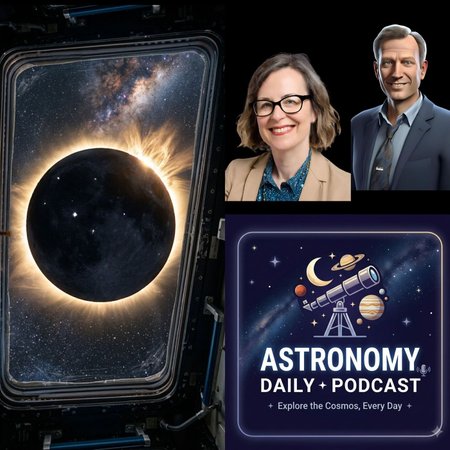
Cosmic Revelations: Artemis 2's Historic Observations and the Case of Hypernovae
Show notes Six months after Artemis II swung around the far side of the Moon, NASA has published what the crew saw, said and sketched — including five faint impact flashes spotted during a 54-minute eclipse. Plus: two UCL papers that take apart the chemical evidence for hypernovae, Juno finds Jupiter's magnetodisk crumpled into ripples, and IISc simulations suggest magnetised white dwarfs could grow well past the Chandrasekhar limit. Skywatch: the crescent Moon meets Antares, Mercury and Venus favour the south, Mars leaves the Beehive, and Vesta at opposition. Artemis II Preliminary Lunar Science Report · Crew: Reid Wiseman, Victor Glover, Christina Koch (NASA) and Jeremy Hansen (CSA); lunar flyby 6 April 2026. · Five extremely faint impact flashes seen from ~74,000 km during a 54-minute eclipse behind the Moon; impactors estimated at no more than ~5 cm. · Crew-reported colours (blue = titanium-rich volcanic rock, brown = iron, green = glass); terminator observations as a proxy for south-pole lighting. · 'Hello, World' Earth image lit by moonlight; labelled southern Milky Way image (Crux, Carina, LMC). · Source: NASA Science, 'Artemis II: Sights & Sounds of Science', 7 Oct 2026 — science.nasa.gov/feature/artemis-ii-preliminary-lunar-science-report/ Hypernovae: the evidence that wasn't · Anmol Aggarwal & Ralph Schoenrich (Mullard Space Science Laboratory, UCL), two MNRAS papers; UCL release 5 Oct 2026. · Uneven ('stochastic') supernova enrichment explains three of four supposed hypernova-enriched stars; the fourth (silver- and uranium-rich halo giant) fits a neutron-star merger plus one ordinary supernova. · Source: ucl.ac.uk/news/2026/oct/ultra-powerful-star-explosions-might-not-have-occurred-after-all ; DOI 10.1093/mnras/stag610 Juno: Jupiter's rippling magnetodisk · Ruilong Guo (Shandong University) et al., Science China Earth Sciences 69(10), 2026; release 6 Oct 2026. · Repeated current-sheet crossings — four in ten minutes in one case — with reconnection signatures; a rotating, rippled sheet rather than a smooth flapping one. · Source: doi.org/10.1007/s11430-025-1870-9 White dwarfs beyond the Chandrasekhar limit · Zenia Zuraiq, Banibrata Mukhopadhyay (IISc) and collaborators incl. Christopher Tout, ApJL 2026; IISc release 9 Oct 2026. · Modified STARS code: a magnetised accreting white dwarf reaches ~2.4 solar masses vs ~1.4 without the field. · Source: iisc.ac.in/events/strong-magnetic-fields-could-allow-white-dwarfs-to-grow-beyond-the-chandrasekhar-limit/ Quick hit: Hera and MMX · ESA: Hera BRM-1, 93-minute braking burn early Thu 15 Oct; BRM-2 on 22 Oct. esa.int (Hera) · JAXA: MMX launch on H3 F10, 20 Oct 2026 04:41:03 JST from Tanegashima; samples to South Australia in 2031. Skywatch (computed for Sydney, LA, New York, London) · Tonight: crescent Moon near Antares — 1.3° from New York, 2.3° from LA and London (very low), 7° from Sydney. · Evening Mercury (24° up at sunset from Sydney) and Venus (heading to inferior conjunction ~24 Oct) favour the south. · Pre-dawn: Mars ~2° from the Beehive, Mars–Jupiter closing to ~1.2° on 16 Nov; Saturn in the evening; Southern Taurids; Vesta at opposition (mag 6.5, Cetus). · Solar safety: never view the Sun except through certified ISO 12312-2 filters. Become a supporter of this podcast: https://www.spreaker.com/podcast/astronomy-daily-latest-space-news--5648921/support . Sponsor Details: Ensure your online privacy by using NordVPN . To get our special listener deal and save a lot of money, visit www.astronomydaily.io/nordvpn . You'll be glad you did! Get the best secure and private email on the planet. Stop your Government, google and who knows who else spying on every email you write. Do what we did and use ProtonMail. They beleive in privacy and there are no ads in their business model...yet they still provide a free forever service. Check them out and get out special deal at www.astronomydaily.io/protonmail Become a supporter of Astronomy Daily by joining our Supporters Club. Commercial free episodes daily are only a click way... Click Here This episode includes AI-generated content.
Astronomy Daily: Latest Space News
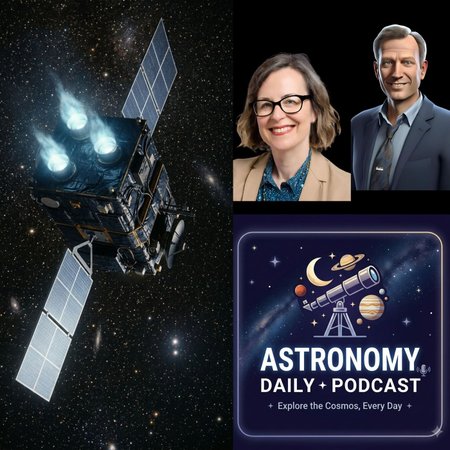
HERA's Grand Maneuver: Braking for Didymos and the Future of Planetary Defence
Show notes Hera Hits the Brakes ESA's Hera spotted its target asteroid for the first time last week and fires its first braking burn on Thursday — 93 minutes of thrust to start stopping at Didymos and Dimorphos, the asteroid pair NASA's DART hit in 2022. Plus: Solar Orbiter traces a solar-wind switchback back to the Sun, Gemini North finds chains of giant knots in the remnant of the supernova of 1181, Webb reads the dust of Mars-sized worlds colliding, and Perseverance becomes the farthest-driving vehicle on another world. In the skywatch: the Moon meets Antares, Venus bows out, Mars and Jupiter rule the northern dawn, and the Orionids are a week away. Hera Hits the Brakes Two years after launch, Hera caught its first glimpse of Didymos from about 236,500 km away — a sub-pixel dot. On Thursday 15 October three hydrazine thrusters fire for 93 minutes (BRM-1), taking a few hundred metres per second off its approach speed; BRM-2 (~31 min) follows on 22 October, then three small transition burns. The first signal after the burn comes through ESA's New Norcia antennas in Western Australia. Hera will measure the mass of Dimorphos so DART's single orbital-period result can become a repeatable deflection technique; its CubeSats Milani and Juventas will study dust, composition and the interior. Solar Orbiter traces a switchback home Coburn et al. (Nature Astronomy, 8 Oct) used heavy-ion charge states measured inside a large switchback crossed on 2 March 2022 to show it formed by interchange reconnection in hot closed loops at the Sun's surface — with waves and turbulence taking over once it left. Both leading theories are right, at different stages. The supernova of 1181 is strung with pearls Cunningham, Caiazzo et al. (ApJ, 6 Oct) used Gemini North/GMOS to show that Pa 30's radial filaments are chains of knots ~100 billion km across. Pa 30 is the Milky Way's only known Type Iax remnant, with a surviving 'zombie' star. The knots constrain models but don't yet settle what formed them. Webb reads the wreckage of colliding worlds Su et al. (ApJ, 1 Oct) studied 21 extreme debris disks with Webb and Spitzer. About a third are silica-rich, consistent with collisions between Mars-sized planetary embryos; older systems should be silica-poor. Quick hit: Perseverance's driving record On 11 October (sol 2,006) Perseverance reached 45.22 km, passing Opportunity's 45.16 km. More than 90% of the distance was driven on AutoNav. Sources · Hera braking campaign (ESA, 7 Oct 2026) — https://www.esa.int/Space_Safety/Hera/Brake!_Time_for_ESA_s_Hera_asteroid_mission_to_go_slow · Hera's first glimpse of Didymos (ESA, 7 Oct 2026) — https://www.esa.int/ESA_Multimedia/Images/2026/10/Destination_sighted_Hera_s_first_glimpse_of_Didymos · Finding Hera's way: Flight Dynamics team in action (ESA, 7 Oct 2026) — https://www.esa.int/Space_Safety/Hera/Finding_Hera_s_way_Flight_Dynamics_team_in_action · Solar Orbiter tracks origin of magnetic switchbacks (ESA, 8 Oct 2026) — https://www.esa.int/Science_Exploration/Space_Science/Solar_Orbiter/Solar_Orbiter_tracks_origin_of_mysterious_magnetic_switchbacks · Coburn et al., Nature Astronomy, DOI 10.1038/s41550-026-02928-0 — https://www.nature.com/articles/s41550-026-02928-0 · Gemini North reveals pearl-like knots in Pa 30 (NOIRLab, 6 Oct 2026) — https://noirlab.edu/public/news/noirlab2624/ · NASA's Webb provides crash course on planet-shattering collisions (NASA) — https://science.nasa.gov/missions/webb/nasas-webb-provides-crash-course-on-planet-shattering-collisions/ · Su et al., ApJ 1010:1, DOI 10.3847/1538-4357/ae88fe — https://doi.org/10.3847/1538-4357/ae88fe · Perseverance sets off-world record for total distance driven (JPL, 12 Oct 2026) — https://www.jpl.nasa.gov/news/nasas-perseverance-sets-off-world-record-for-total-distance-driven/ Become a supporter of this podcast: https://www.spreaker.com/podcast/astronomy-daily-latest-space-news--5648921/support . Sponsor Details: Ensure your online privacy by using NordVPN . To get our special listener deal and save a lot of money, visit www.astronomydaily.io/nordvpn . You'll be glad you did! Get the best secure and private email on the planet. Stop your Government, google and who knows who else spying on every email you write. Do what we did and use ProtonMail. They beleive in privacy and there are no ads in their business model...yet they still provide a free forever service. Check them out and get out special deal at www.astronomydaily.io/protonmail Become a supporter of Astronomy Daily by joining our Supporters Club. Commercial free episodes daily are only a click way... Click Here This episode includes AI-generated content.
Astronomy Daily: Latest Space News
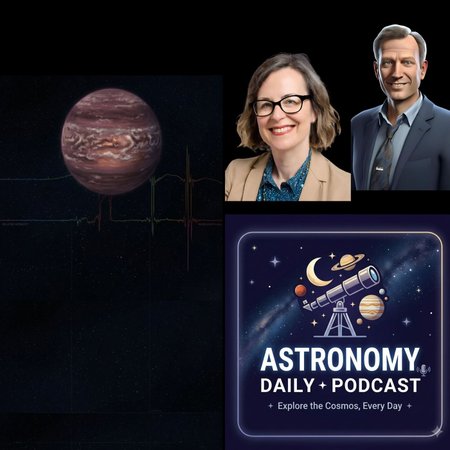
Cloudy with a Chance of Water: The Mysteries of WISE 0855 Unveiled
The coldest brown dwarf we know has weather. JWST watched water clouds thicken and thin on WISE 0855, a sunless world seven and a half light-years away — plus a star slowly eating a brown dwarf, ten minutes of X-rays after a half-second burst, a Soviet satellite breaking up over Western Australia, NASA's lunar cave hunt, and Mercury's best evening show of the year for the south. Stories Weather on a World Without a Sun Miles et al. used JWST NIRSpec to take a spectrum of WISE 0855 every 15 minutes for 11 hours. Carbon monoxide and phosphine rise and fall together as convection dredges deep gas upward, while patchy water clouds thicken and thin higher up — the first variable water clouds seen outside the Solar System. Source: University of Arizona release, 9 Oct 2026; arXiv:2609.20664 The Star That Eats Slowly ZTF J0440+2325: a red dwarf drawing gas from a 25-Jupiter-mass brown dwarf on an 87-minute orbit — the first confirmed stable mass transfer from a substellar object onto a star. Householder, Burdge et al., Nature Astronomy, 5 Oct 2026. Source: Nature Astronomy (2026); arXiv:2603.17039 Ten Minutes After Half a Second Einstein Probe caught ~560 s of soft X-rays after the 0.37 s GRB 250704B, at redshift 0.661 with no supernova — pointing to a compact-object merger and possibly a newborn magnetar. Science Bulletin, 2026. Source: DOI 10.1016/j.scib.2026.08.021; arXiv:2601.14137 A Dead Satellite Comes Apart Soviet weather satellite Meteor 2-7 (launched 1981) fragmented on 5 Oct at ~850 km, detected by LeoLabs' Western Australian radar. Cause unknown. Source: EarthSky, 9 Oct 2026; Space.com Quick hit: NASA Goes Caving on the Moon NASA's PRISM picks for the Moon Base program include GIMLI, which will probe the Marius Hills Pit for a lava tube, plus LEMS-SP and DISCO. Source: NASA RELEASE26-080, 30 Sept 2026 Skywatch Mercury at greatest eastern elongation — 24° up at sunset from Sydney vs 10° LA, 7.5° NY, 3° London. Crescent Moon near Venus and Mercury, Venus heading to inferior conjunction on the 24th, pre-dawn Mars and Jupiter for the north (Mars through the Beehive), Orionids 21–22 Oct. Source: Computed with PyEphem Sources · https://astrobiology.com/2026/10/09/first-detection-of-variable-water-clouds-outside-of-our-solar-system/ · https://arxiv.org/abs/2609.20664 · https://dspace.mit.edu/handle/1721.1/175765 · https://arxiv.org/abs/2603.17039 · https://www.arxiv.org/abs/2601.14137 · https://earthsky.org/?p=560313 · https://www.space.com/space-exploration/satellites/a-dead-soviet-satellite-just-broke-apart-in-orbit-again-experts-say-its-part-of-a-worrying-trend · https://nasa.gov/news-release/nasa-adds-new-science-investigations-for-moon-base Become a supporter of this podcast: https://www.spreaker.com/podcast/astronomy-daily-latest-space-news--5648921/support . Sponsor Details: Ensure your online privacy by using NordVPN . To get our special listener deal and save a lot of money, visit www.astronomydaily.io/nordvpn . You'll be glad you did! Get the best secure and private email on the planet. Stop your Government, google and who knows who else spying on every email you write. Do what we did and use ProtonMail. They beleive in privacy and there are no ads in their business model...yet they still provide a free forever service. Check them out and get out special deal at www.astronomydaily.io/protonmail Become a supporter of Astronomy Daily by joining our Supporters Club. Commercial free episodes daily are only a click way... Click Here This episode includes AI-generated content.
Astronomy Daily: Latest Space News
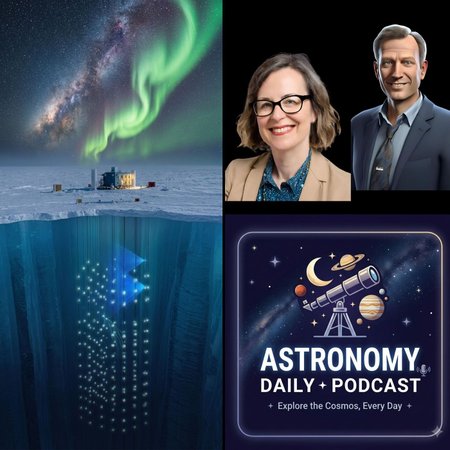
A Nobel in Ice: Unveiling the Secrets of the IceCube Neutrino Observatory
Show notes We're back after a short break! Today: the 2026 Nobel Prize in Physics goes to Francis Halzen for the IceCube Neutrino Observatory — a cubic kilometre of Antarctic ice turned into a telescope. Then a Sydney-led team publishes the most distant fast radio burst yet, from a dwarf galaxy just 3 billion years after the big bang; Hubble's archive yields a possible second-generation planet around a white dwarf; and we catch up on Starship's first orbit, Crew-13, Juice's Earth flyby and the end of the LINK/Swift story. Skywatch: zodiacal light at both ends of the day, Mercury above Venus in southern twilight, and Mars in the Beehive for the north. Segment 1 — LEAD: The Telescope Made of Ice · Nobel Prize in Physics 2026 — nobelprize.org/prizes/physics/2026 (6 Oct 2026) · Royal Swedish Academy of Sciences press release, 6 Oct 2026 · AIP congratulations release, Newswise, 6 Oct 2026 · University of Wisconsin–Madison / IceCube background (via Interesting Engineering, 6 Oct 2026) Segment 2 — The Most Distant Fast Radio Burst · NASA: 'Webb Measures Distance to Farthest Fast Radio Burst, Suggesting Origin', 8 Oct 2026 · Caleb et al., Science, 8 Oct 2026, DOI 10.1126/science.adz2675 · Preprint: arXiv 2508.01648, 3 Aug 2025 (14-month gap disclosed) Segment 3 — A Planet Built From a Dead Star · NASA: 'Suspected Second-generation Planet Solves NASA Hubble Cold Case', 5 Oct 2026 · Williams et al., Nature Astronomy, 5 Oct 2026, DOI 10.1038/s41550-026-02983-7 · ESA/Hubble heic2613; poster, UK White Dwarf meeting, Durham, July 2025 (disclosed) Segment 4 — While We Were Away · SpaceX Starship Flight 14 overview (via leonarddavid.com, 29 Sept 2026) · NASA: 'NASA's SpaceX Crew-13 Launches', 1 Oct 2026 · ESA: 'Successful Earth flyby improves Juice's course to Jupiter', 28–30 Sept 2026 · AP (Marcia Dunn): 'Private spacecraft falls back to Earth...', 25 Sept 2026 · JAXA: MMX launch schedule aboard H3 F10, 20 Aug 2026 Segment 5 — Skywatch: Both Hemispheres · PyEphem 4.2.1 computations, Sydney / Los Angeles / New York / London · BBC Sky at Night: Vesta and Pallas at opposition, Oct 2026 · NASA: What's Up, October 2026 Become a supporter of this podcast: https://www.spreaker.com/podcast/astronomy-daily-latest-space-news--5648921/support . Sponsor Details: Ensure your online privacy by using NordVPN . To get our special listener deal and save a lot of money, visit www.astronomydaily.io/nordvpn . You'll be glad you did! Get the best secure and private email on the planet. Stop your Government, google and who knows who else spying on every email you write. Do what we did and use ProtonMail. They beleive in privacy and there are no ads in their business model...yet they still provide a free forever service. Check them out and get out special deal at www.astronomydaily.io/protonmail Become a supporter of Astronomy Daily by joining our Supporters Club. Commercial free episodes daily are only a click way... Click Here This episode includes AI-generated content.
Astronomy Daily: Latest Space News
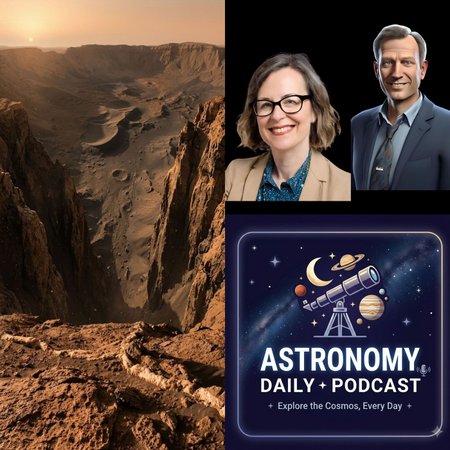
The Great Water Mystery: Jezero Crater and the Hunt for Mars' Hidden History
Perseverance drove to the edge of an ancient Martian lake expecting a beach and found the inside of a volcano — rock that water has been through at least three separate times. Europe's Jupiter probe comes home on Monday night and crosses Australia in a fully dark sky. Two teams, using two completely different techniques, both find something hiding inside the most famous planetary system we have ever photographed — and an Australian instrument is in the middle of one of them. Plus: heavy water in an interstellar comet, and what it says about the star that made it. In this episode · LEAD — Three floods at the crater's edge. Candice Bedford (Purdue) and colleagues publish in Communications Earth & Environment: the Margin Unit at Jezero is igneous, not sedimentary, and records at least three distinct episodes of water — CO₂-rich groundwater making carbonate ridges, then silica associated with the lake, then a later hot-water event leaving fluorite veins. Habitability context, not a biosignature. · Juice returns. ESA confirms the third Earth gravity assist for 28 September — closest approach 11:45 UTC over the Indian Ocean, bending the trajectory ~20° and adding ~3.5 km/s. The spacecraft crosses Australia north-east to north-west 15–30 minutes earlier, in full darkness. · HR 8799. Two preprints in two weeks point at a fifth, inner planet — one from archival JWST aperture-masking data (~7 au, a few Jupiter masses), one from Gaia astrometry (2–3 au, 10–14 Jupiter masses). They do not obviously describe the same object. Neither is peer-reviewed. · 3I/ATLAS. A modelling paper explains the high deuterium-to-hydrogen ratio measured in March as consistent with formation around a low-metallicity — meaning old — star. · Quick hit: Starship Flight 14 still targeting 28 September; Crew-13 still 'no earlier than early October' on NASA's own page; Albania signs the Artemis Accords as the 73rd country. · Skywatch: the equinox as an instant rather than a date, the Juice pass over Australia, Venus and Mercury for the south, Mars and Jupiter before dawn for the north, and Saturn heading into opposition. Sources and further reading · Bedford, C. C. et al., 'Lake- and groundwater-associated alteration of the olivine-rich Margin unit in Jezero crater, Mars', Communications Earth & Environment (2026). DOI 10.1038/s43247-026-03997-9 · NASA/JPL, 'NASA Discovery Reveals Complex Water Systems on Early Mars', 21 September 2026. · ESA, 'Juice to fly past Earth for third gravity assist', 21 September 2026. · Nguyen, J. S. et al., 'A Candidate Innermost Fifth Planet In the HR 8799 System Revealed By JWST NIRISS Aperture Masking Interferometry', arXiv:2609.10507. · Lagrange, A.-M. et al., 'A fifth companion in the HR 8799 system revealed by Gaia', arXiv:2609.20996 (submitted to Nature Astronomy). · Furuya, K., Cordiner, M., Bockelée-Morvan, D. et al., arXiv:2609.12370. · NASA OIIR, 'NASA Welcomes Albania as Newest Artemis Accords Signatory', 21 September 2026. Skywatch figures computed in-session with PyEphem 4.2.1 for Sydney, Los Angeles, New York and London. Times are local unless marked UTC. Become a supporter of this podcast: https://www.spreaker.com/podcast/astronomy-daily-latest-space-news--5648921/support . Sponsor Details: Ensure your online privacy by using NordVPN . To get our special listener deal and save a lot of money, visit www.astronomydaily.io/nordvpn . You'll be glad you did! Get the best secure and private email on the planet. Stop your Government, google and who knows who else spying on every email you write. Do what we did and use ProtonMail. They beleive in privacy and there are no ads in their business model...yet they still provide a free forever service. Check them out and get out special deal at www.astronomydaily.io/protonmail Become a supporter of Astronomy Daily by joining our Supporters Club. Commercial free episodes daily are only a click way... Click Here This episode includes AI-generated content.
Astronomy Daily: Latest Space News
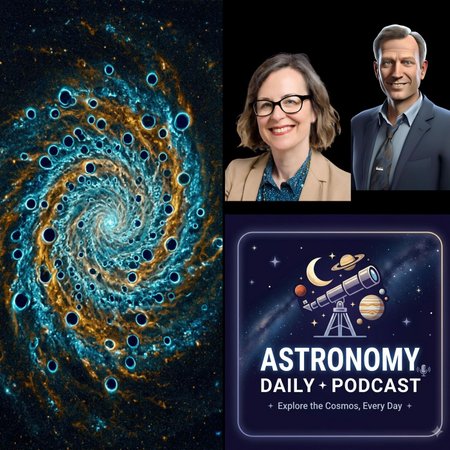
What Keeps a Galaxy Churning: Andromeda's Supernova Secrets Revealed
Supernovae keep galaxies churning A new study led by Fan Yi Meng from Tsinghua University provides the first comprehensive census of superbubbles in the Andromeda Galaxy, revealing that clustered supernova feedback is sufficient to sustain galactic-scale turbulence. This finding helps to explain why galaxies remain active over billions of years, with turbulence playing a crucial role in regulating star formation rates. The research, published in Nature Astronomy, highlights the energy balance between supernovae and the turbulence they create. Neutrinos may dictate stellar explosions A paper from Mariam Gogilashvili and Irene Tambora at the Niels Bohr Institute explores the role of neutrinos in determining which massive stars explode as supernovae. Their findings suggest that neutrino oscillations could lead to a significant number of stars collapsing into black holes, particularly those in the 16 to 30 solar mass range, addressing the long-standing red supergiant problem. TOI 1355b: A planet with an expiry date Researchers from the University of Tokyo have discovered TOI 1355b, a hot Jupiter with a unique eccentric orbit around an A-type star. This planet will stop transiting its host star by 2033 due to nodal precession, providing a rare opportunity to study its characteristics before it disappears from view. SpaceX Crew Missions Update NASA has contracted SpaceX for three additional crew rotation missions to the International Space Station, extending their partnership and ensuring continued access to the station. Crew 13 is currently in quarantine, with a launch targeted for early October. The Sun goes blank For the first time since February, the Sun has gone completely spotless, marking a significant moment in the solar cycle. As solar activity declines, a coronal hole is set to rotate into position, potentially leading to minor geomagnetic storms and auroras.1. Supernovae keep galaxies churning2. Neutrinos may dictate stellar explosions3. TOI 1355b: A planet with an expiry date4. SpaceX Crew Missions Update5. The Sun goes blankBecome a supporter of this podcast: https://www.spreaker.com/podcast/astronomy-daily-latest-space-news--5648921/support . Sponsor Details: Ensure your online privacy by using NordVPN . To get our special listener deal and save a lot of money, visit www.astronomydaily.io/nordvpn . You've been glad you did! Get the best secure and private email on the planet. Stop your Government, Google and who knows who else spying on every email you write. Do what we did and use ProtonMail. They believe in privacy and there are no ads in their business model... yet they still provide a free forever service. Check them out and get our special deal at www.astronomydaily.io/protonmail Become a supporter of Astronomy AstroDailyPod by joining our Supporters Club. Commercial-free episodes daily are only a click away... Click Here Sponsor Details: Ensure your online privacy by using NordVPN . To get our special listener deal and save a lot of money, visit www.astronomydaily.io/nordvpn . You'll be glad you did! Get the best secure and private email on the planet. Stop your Government, google and who knows who else spying on every email you write. Do what we did and use ProtonMail. They beleive in privacy and there are no ads in their business model...yet they still provide a free forever service. Check them out and get out special deal at www.astronomydaily.io/protonmail Become a supporter of Astronomy Daily by joining our Supporters Club. Commercial free episodes daily are only a click way... Click Here This episode includes AI-generated content.
Astronomy Daily: Latest Space News
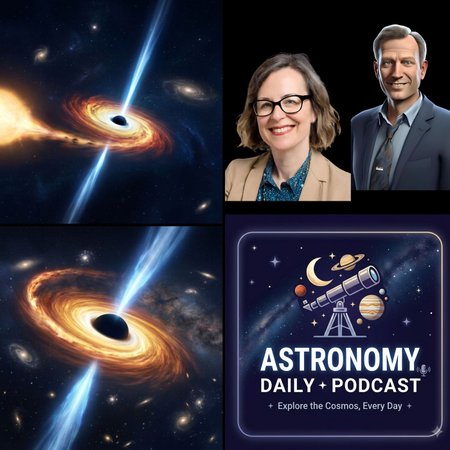
The Unifying Mystery of Black Hole Jets: Stellar and Supermassive Connections
SHOW NOTES Black hole jets follow one universal rule Adelle Goodwin (Curtin University / ICRAR, Forrest Research Foundation Fellow) and Andrew Mummery (Institute for Advanced Study, Princeton) show that supermassive black holes launch their outflows at the same critical accretion rate as stellar-mass black holes — about 2% of the Eddington limit — making accretion-outflow coupling scale-invariant across seven orders of magnitude in mass. Nature Astronomy, 17 September 2026. DOI: 10.1038/s41550-026-02951-1 JWST's Little Red Dots are black hole seeds caught mid-growth Sunmyon Chon, Shingo Hirano, Tomoaki Ishiyama, Seok-Jun Chang and Volker Springel ran fully cosmological radiation-hydrodynamic simulations on Japan's ATERUI III supercomputer and produced heavy black hole seeds of about a million solar masses, whose optically thick discs generate exactly the broad hydrogen emission seen in Little Red Dots. Nature 657, 621-625, 16 September 2026. DOI: 10.1038/s41586-026-10985-8 Earth's centre of mass moves about half as far as we thought Donald Argus, Felix Landerer and colleagues at NASA's Jet Propulsion Laboratory, with the University of Nevada, the University of Montana and the Helmholtz Centre for Geosciences, revise the annual oscillation between Earth's centre of mass and its centre of figure down from roughly 11 millimetres to about 4 to 5.5. Geophysical Journal International, ggag314. DOI: 10.1093/gji/ggag314 Two numbers explain the weather on a world 20 light-years away Merle Schrader and colleagues at Trinity College Dublin applied principal component analysis to one rotation of JWST spectroscopy of the brown dwarf SIMP 0136 and found two components — temperature and vertical cloud structure — account for all the detectable variability. Astronomy & Astrophysics, open access. DOI: 10.1051/0004-6361/202660109 The Sun goes blank With only active region AR4528 left on the Earth-facing disc and rotating out of view, the Sun was on the verge of its first spotless day since 24 February 2026 — which itself ended a 1,335-day run of continuous sunspot activity stretching back to June 2022. Skywatch: Venus at greatest brilliancy, first quarter Moon, Observe the Moon Night Venus reaches greatest brilliancy on 18 September at magnitude -4.8; the Moon reaches exact first quarter at 20:43 UTC the same day, setting up International Observe the Moon Night on Saturday 19 September. All times and altitudes in this segment were computed for Sydney, Los Angeles, New York and London. SKYWATCH — COMPUTED REFERENCE Computed in-session with PyEphem 4.2.1. Local times. Sydney on AEST (UTC+10); Los Angeles PDT; New York EDT; London BST. City Sunset Venus alt Venus sets Mercury Mars pre-dawn Sydney 17:45 39.2 deg 20:58 (3h13m) 16.4 deg (sets 1h20m) 20.4 deg Los Angeles 18:52 14.3 deg 20:10 (1h19m) 8.8 deg (sets 0h43m) 48.4 deg New York 18:56 10.3 deg 19:59 (1h03m) 7.0 deg (sets 0h38m) 46.1 deg London 19:04 3.6 deg 19:32 (0h28m) 3.9 deg (sets 0h26m) 40.6 deg · Venus greatest brilliancy: 18 September 2026, magnitude -4.8. Disc 39.6 arcsec, 26% illuminated. · By 22 September the disc has grown to 42.3 arcsec but the lit fraction has fallen to 22.7% — the two changes nearly cancel, which is why listings disagree on the date. The peak is genuinely flat. · Moon reaches exact first quarter 18 September at 20:43 UTC = 06:43 AEST Sat 19 Sep / 16:43 EDT Fri 18 / 13:43 PDT Fri 18 / 21:43 BST Fri 18. · Moon altitude at sunset: Sydney 81.6 deg (near overhead), Los Angeles 27.1 deg, New York 20.4 deg, London 9.4 deg. · International Observe the Moon Night: Saturday 19 September 2026. NASA event at the U.S. Space & Rocket Center, Huntsville, 5:30-8:00pm CST. · Pre-dawn Sat 19 Sep at nautical dawn — Jupiter: Los Angeles 26.4 deg, New York 25.1 deg, London 21.9 deg, Sydney 8.9 deg. · Mars-Jupiter separation: 22.9 deg on 18 Sep, 12.0 deg mid-October, 1.2 deg mid-November 2026. · Saturn is up essentially all night; sets 06:47 Sydney, 07:55 Los Angeles. Opposition 4 October 2026, disc 19.6 arcsec, rings approx 7 deg open. · September equinox: a single instant, 00:05:09 UTC on 23 September 2026 — evening of the 22nd in the Americas, mid-morning of the 23rd in Australia. · All figures computed in-session with PyEphem 4.2.1 for the four reference cities. Sydney is on AEST (UTC+10); daylight saving begins 4 October. Become a supporter of this podcast: https://www.spreaker.com/podcast/astronomy-daily-latest-space-news--5648921/support . Sponsor Details: Ensure your online privacy by using NordVPN . To get our special listener deal and save a lot of money, visit www.astronomydaily.io/nordvpn . You'll be glad you did! Get the best secure and private email on the planet. Stop your Government, google and who knows who else spying on every email you write. Do what we did and use ProtonMail. They beleive in privacy and there are no ads in their business model...yet they still provide a free forever service. Check them out and get out special deal at www.astronomydaily.io/protonmail Become a supporter of Astronomy Daily by joining our Supporters Club. Commercial free episodes daily are only a click way... Click Here This episode includes AI-generated content.
Astronomy Daily: Latest Space News
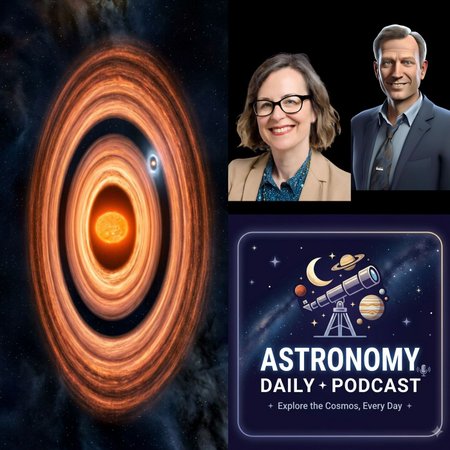
The Youngest Planet Ever Found
Astronomers have confirmed the youngest planet ever found - Elias 2-24 b, less than a million years old, sitting inside a gap it is carving in its own birth disc 450 light-years away. Plus: the Lunar Reconnaissance Orbiter finds a 222-metre crater that was not there in 2024, a 178-year-old space weather record gets corrected by seven years, and Sakurai's Object - a star that came back from the dead - has become six times hotter in thirty years. SOURCES Newfound 'Baby' Planet Smashes Record for Youngest Known World NASA Science, 16 September 2026 - https://science.nasa.gov/universe/newfound-baby-planet-smashes-record-for-youngest-known-world/ Elias 2-24 b discovery paper Bernardi, Cieza et al., The Astrophysical Journal Letters, 16 September 2026, DOI 10.3847/2041-8213/ae9bb6 - https://doi.org/10.3847/2041-8213/ae9bb6 ALMA Observations of Elias 2-24: A Protoplanetary Disk with Multiple Gaps (background) Cieza et al., ApJL 851 L23, 2017, DOI 10.3847/2041-8213/aa9b7b - https://doi.org/10.3847/2041-8213/aa9b7b NASA's Moon Orbiter Spots New, 'Once-in-Century' Moon Crater NASA Science, 16 September 2026 - https://science.nasa.gov/solar-system/moon/nasas-moon-orbiter-spots-new-once-in-century-moon-crater/ New 222-metre lunar crater - mission release W. M. Keck / Intuitive Machines / NASA LROC, 16 September 2026; two papers in Science Advances (Robinson et al., morphology and ejecta; Powell et al., Diviner thermal signature) - https://www.prnewswire.com/news-releases/nasas-lunar-reconnaissance-orbiter-discovers-a-new-222-m-diameter-lunar-crater-302880555.html Mystery of one of the earliest recorded space weather impacts solved Lancaster University / RMIT University, 16 September 2026; Wild, Carter, Hapgood et al., Space Weather (AGU), DOI 10.1029/2026SW005239 - https://doi.org/10.1029/2026SW005239 'Born-again' star offers rare chance to watch stellar evolution in real time The University of Manchester, 16 September 2026; Zijlstra, van Hoof et al., 'The emergence of a [WC] star in Sakurai's object', MNRAS, DOI 10.1093/mnras/stag1533 - https://doi.org/10.1093/mnras/stag1533 Cargo Mission and Crew-13 Updates; Station Research, Maintenance Continue NASA Space Station Blog, 16 September 2026 - https://www.nasa.gov/blogs/spacestation/2026/09/16/cargo-mission-and-crew-13-updates-station-research-maintenance-continue/ International Observe the Moon Night 2026 NASA, Saturday 19 September 2026 - https://science.nasa.gov/moon/observe-the-moon-night/overview Skywatch ephemerides Computed in-session with PyEphem for Sydney, Los Angeles, New York and London, 17-18 September 2026 Become a supporter of this podcast: https://www.spreaker.com/podcast/astronomy-daily-latest-space-news--5648921/support . Sponsor Details: Ensure your online privacy by using NordVPN . To get our special listener deal and save a lot of money, visit www.astronomydaily.io/nordvpn . You'll be glad you did! Get the best secure and private email on the planet. Stop your Government, google and who knows who else spying on every email you write. Do what we did and use ProtonMail. They beleive in privacy and there are no ads in their business model...yet they still provide a free forever service. Check them out and get out special deal at www.astronomydaily.io/protonmail Become a supporter of Astronomy Daily by joining our Supporters Club. Commercial free episodes daily are only a click way... Click Here This episode includes AI-generated content.
audio playback progress

0:00:00-:--:--